0
What if the need for control isn't something to get rid of, but something to become curious about? Explore what control may reveal about the maps you use to navigate uncertainty.
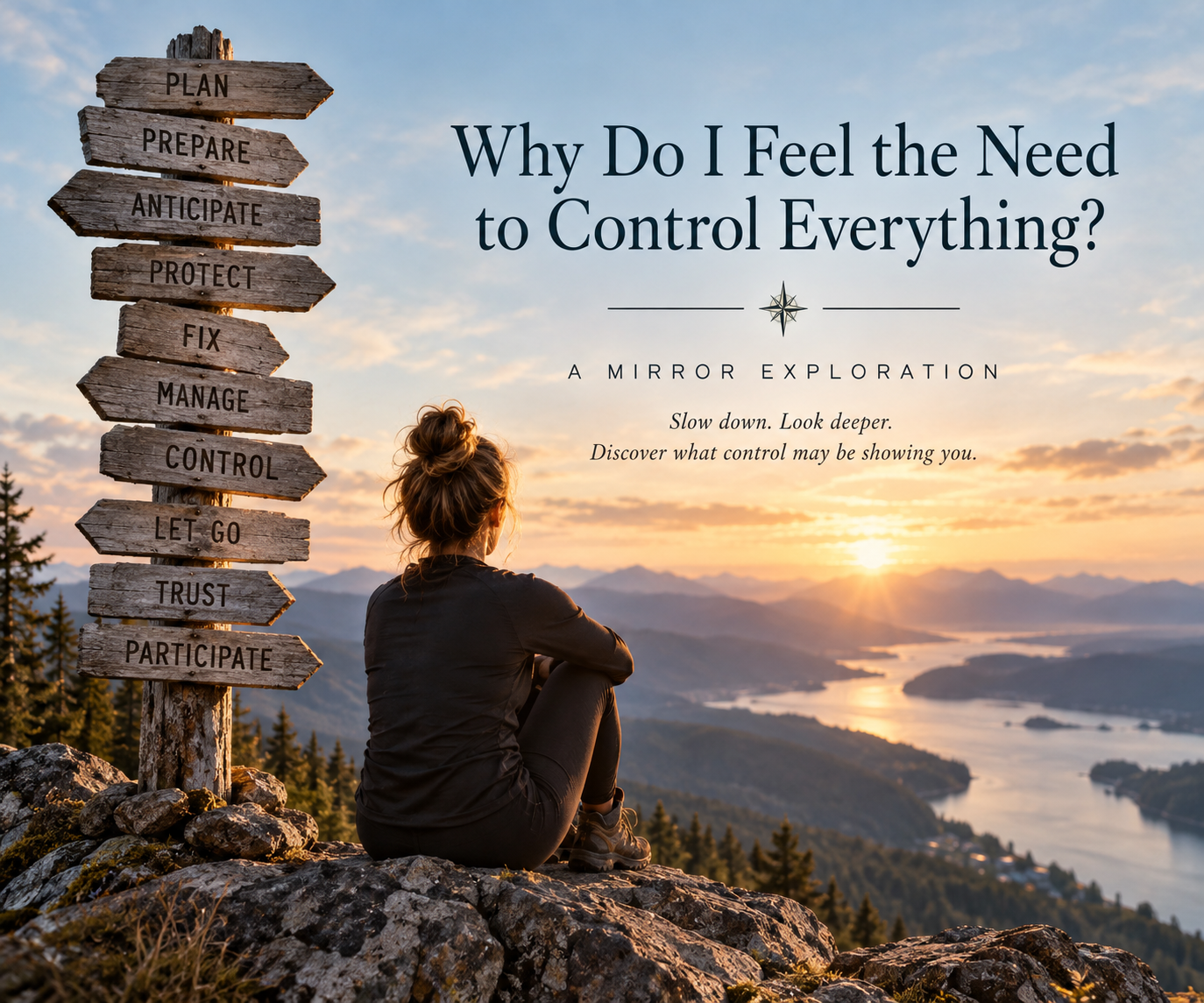
You notice yourself planning ahead.
Thinking through what could go wrong.
Wanting to know what someone is going to do
before they do it.
Wanting to know what someone is going to do
before they do it.
Feeling frustrated when plans suddenly change.
Maybe you replay conversations.
Prepare for possibilities that haven't happened.
Step in when someone else is doing something
differently than you would.
Want an answer before there is one.
And somewhere along the way, you may have
started describing yourself as controlling.
Maybe someone else has described you that way
too.
But what if we didn't begin there?
What if, instead of deciding that your need for
control is something you need to fix, we became
curious about what you are
actually calling control?
What becomes possible when you know what
is going to happen?
And perhaps more interestingly:
What happens when you don't?
That is a very different place to begin.
Think about the moments when you are most
likely to describe yourself as controlling.
Not your entire life.
Just ordinary moments.
Someone changes the plan.
Someone doesn't respond when you expected
them to.
You are waiting for an answer.
Someone else is responsible for something that
matters to you.
You have a particular way you want something
done.
Something isn't happening as quickly as you
would like.
You don't know what is going to happen next.
What do you notice yourself doing?
Maybe you make another plan.
Send another text.
Check again.
Ask another question.
Take over.
Think through every possible outcome.
Try to make a decision.
Perhaps you simply become uncomfortable.
There is no need to decide what any of this
means.
For now, just notice:
These are some of the experiences I have been
calling control.
We use the word control as though everyone
knows exactly what it means.
But look at how much of everyday life involves
trying to influence what happens next.
You set an alarm because you want to wake up at
a particular time.
You make a reservation because you want a
table when you arrive.
You look at the weather before leaving the
house.
You create a budget because you want to
participate with where your money goes.
You make plans.
You lock your doors.
You schedule appointments.
You tell someone what you need.
You prepare.
You organize.
You make choices today based on what you
believe might happen tomorrow.
Are all of those things control?
Maybe.
But if they are, then control itself may not tell us
very much.
Perhaps what matters is the relationship we have
with it.
This is where language gets interesting.
You probably don't describe yourself as
controlling every time you put something on
your calendar.
So when does planning become controlling?
When does preparing become controlling?
When does wanting something become
controlling?
When does asking become controlling?
When does trying to influence an outcome
become controlling?
And who decided where that line is?
You?
Someone else?
A past relationship?
Your family?
Something you've read?
A therapist?
Social media?
A moment when someone told you:
You always have to be in control.
Sometimes a word becomes a description.
Then, without realizing it, the description becomes
an identity.
I am controlling.
Once that happens, we may stop looking at the
individual experiences altogether.
We already have an explanation for them.
That's just how I am.
But a label can sometimes hide as much as it
reveals.
Imagine two people planning the same trip.
One books the hotel six months ahead.
The other books it the night before leaving.
Which one is controlling?
We don't actually have enough information to
know.
Maybe neither.
Maybe both.
Maybe the person who planned six months
ahead genuinely enjoys planning.
Maybe the person who waited until the night
before spent six months worrying about making
the wrong choice.
The behavior alone doesn't tell us the entire
story.
Now bring that back to yourself.
Instead of beginning with:
Why am I so controlling?
What happens if you begin with:
What am I actually doing right now?
Planning?
Preparing?
Predicting?
Organizing?
Waiting?
Checking?
Asking?
Choosing?
Trying to influence something?
Trying to make something happen?
Trying to keep something from happening?
Notice how quickly one large label begins
becoming a collection of very different
experiences.
You don't have to decide whether any of them
are good or bad.
You are simply getting more specific about what
is actually happening.
We all develop ways of navigating life.
We learn how much preparation feels useful.
How much information we like before making a
decision.
How comfortable we are when plans change.
How far ahead we prefer to look.
How much responsibility we want to hold.
How easily we allow someone else to choose.
Those become part of the map we use to move
through the world.
And maps can be useful.
The interesting part begins when we realize:
The map is not the landscape.
Something that once seemed obvious may
deserve another look.
Something you've called control for years may
contain more than one thing.
Something you've been trying to stop doing may
not need to be judged before it can be
understood.
And something you've considered simply part of
your personality may actually be worth
becoming curious about.
You arrived here with a question:
Why do I feel the need to control everything?
Maybe you still have that question.
You don't need to answer it yet.
But perhaps there are some new questions
sitting beside it now.
What do I actually mean by control?
Which moments do I label as controlling?
What am I doing in those moments?
And perhaps:
Is everything I've been calling control actually
the same thing?
You don't have to fix anything you've noticed.
You don't have to become better at letting go.
You don't have to replace control with trust,
surrender, freedom, or anything else.
For now, you can simply notice that there may be
more in the picture than the word control
allowed you to see.
And sometimes seeing that is enough to open a
door.
If Control has your attention, the Control Mirror Contemplation gives you a place to explore your own relationship with certainty, protection, outcomes, and participation—without asking you to give anything up or telling you what your experience should mean.
Explore the Control Mirror